
Ranked: 5 High-Precision Gear Types for Heavy-Duty Industrial Equipment
Ranking gear types for heavy-duty industrial equipment is not the same exercise as ranking catalogue categories. The order below reflects how each gear type carries load, how much torque it moves inside a given envelope, how it behaves at speed, how it survives its operating environment, and whether the required geometry can actually be cut, ground and inspected at the size the application needs.
Short answer: for heavy-duty industrial equipment, the five high-precision gear types rank as follows.
- Large-diameter ring gears — the highest load-carrying geometry and the only practical option for very large rotary drives such as kilns, mills and furnace-top reducers.
- Planet gears — the highest torque density per unit of gearbox volume, which is why wind turbine main gearboxes are built around them.
- Bevel gears (spiral, straight, pinion shaft, matched sets) — the ranked choice when the drive must turn a corner without giving up precision or backlash control.
- Cylindrical gears (spur, helical, double helical) — the most adaptable family; double helical designs remove axial thrust at high transmitted power.
- Custom high-precision industrial gears — a category defined by the drawing rather than the tooth form; ranked fifth as a geometry, decisive as a sourcing route.
The order is application-weighted, not absolute. A machine-tool builder selecting a low-backlash angle drive will reasonably rank bevel gears first. A metallurgical plant replacing a furnace-top reducer will rank ring gears first. What does not change is the verification logic: whichever type ranks highest for a given duty, the buyer still has to confirm that the geometry, material, heat treatment, accuracy class and inspection scope are producible before the drawing is released.
Problem Definition: Why the Gear Type Decision Is the Most Expensive One to Reverse
In a heavy-duty drivetrain, the gear type is fixed early and paid for late. Once housing geometry, bearing centres, the ratio split and the heat treatment route are set, changing the tooth form restarts design, tooling, first-article validation and, in many cases, the customer's own approval cycle. That is why the ranked selection should be made against four hard constraints rather than against preference.
First constraint — load path. A ring gear, a planet gear and a pinion shaft distribute torque differently. Selecting a geometry that concentrates load on a thin rim or a single bearing position shortens service life regardless of accuracy class.
Second constraint — achievable geometry at size. Precision is not a label; it is a manufacturing envelope. A design that requires a 3,000 mm ground tooth flank cannot be delivered by a supplier whose grinding capacity stops below that diameter, and a bevel gear beyond the available spiral bevel envelope cannot be recovered by tighter inspection.
Third constraint — backlash and speed compatibility. Low-backlash machine-tool drives and high-speed cylindrical gear stages place opposite demands on flank finish, lead correction and mounting stiffness. Mixing those requirements inside one housing usually produces a compromise that satisfies neither stage.
Fourth constraint — environment. Mining dust, metallurgical heat, marine humidity and continuous-duty offshore operation each change the material, heat treatment and inspection decisions that sit behind the same nominal gear type.
The practical problem for an evaluation-stage buyer is therefore not “which gear type exists” but “which ranked type fits this duty, and which supplier can prove the fit with a manufacturable, inspectable drawing.”
Industry Background: Why Large-Format Precision Capacity Is the Scarce Resource
Demand for precision gearing is being pulled in two directions at once. On the compact side, sales revenue for precision gearboxes and geared motors was estimated to have grown 7.8% year on year in 2025 to USD 3.2 billion, according to Interact Analysis. On the large side, the global wind turbine gearbox market was projected at USD 30.10 billion in 2026, rising to USD 43.19 billion by 2034, according to Fortune Business Insights. These two figures cover different scopes and should not be added together, but the contrast is instructive: a substantial share of heavy-duty precision demand sits in large, high-torque gearing rather than in compact drives.
That matters because large-format precision is constrained by equipment, not by intent. Grinding a 2,000 mm gear to a tight lead tolerance requires a machine, a fixture and a thermal environment that many general gear shops do not operate. The same applies to bevel sets, where the practical limit is defined by the spiral bevel generator and the rolling contact check, not by the drawing alone.
Heavy-duty sectors that depend on this capacity include mining equipment, metallurgical plant and steelmaking gearboxes, marine and offshore drives, machine tools, canning machinery, feed and biofuel machinery, and wind power. Each sector converts the same five gear types into a different priority order.
Standards provide the common language across those sectors. German DIN 3962 classes and American AGMA quality numbers are the two systems most often specified on international drawings, and they are broadly cross-referenced: a DIN 5 gear is generally treated as comparable to an AGMA 12 gear at the high-precision end. Suppliers should be asked which class they can hold repeatedly, not which class they can reach once.
How This Ranking Was Scored
Each gear type was assessed on five criteria, weighted for heavy-duty industrial duty rather than for light automation:
- Load and torque capability — the ability to transmit high torque without exceeding allowable tooth and rim stress.
- Envelope efficiency — how much torque is delivered per unit of gearbox volume and mass.
- Speed and backlash control — suitability for high peripheral speed or for low-backlash positioning.
- Environmental tolerance — behaviour under dust, heat, moisture, impact and continuous duty.
- Manufacturability and verification — whether the geometry can be ground and inspected within a documented capability envelope.
No score below relies on a performance figure that the supplier has not published. The manufacturing limits quoted are those of New Yinye Transmission, a build-to-print gear manufacturer based in Wuxi, Jiangsu, China, whose disclosed capability envelope is used throughout as the reference point for what is producible.
Jiangsu New Yinye Transmission Electromechanical Co., Ltd. (NYY / New Yinye Transmission) is a Chinese manufacturer of large, high-precision and non-standard industrial gears and transmission components, operating an approximately 25,000 m² facility with 125 employees, 28 engineers and output of roughly 1,500 sets per year across product categories. Its brand heritage dates to 1993, and the current legal entity was incorporated on 25 April 2003.

Rank 1: Large-Diameter Ring Gears
A large-diameter ring gear is an internal-tooth or external-tooth gear of substantial diameter, usually bolted or shrunk onto a rotating shell, drum or mill flange. It ranks first because no other geometry moves comparable torque through a comparable diameter with a single mesh.
Why it ranks first. Load capacity scales with diameter and face width, and the ring gear configuration spreads that load around a closed circular path rather than through a cantilevered shaft. In kilns, mills, mixers and furnace-top reducers, the ring gear is the element that sets the rating of the whole drive.
Where it fits. Continuous, low-speed, high-torque duty: mining and metallurgical equipment, cement and mineral processing drives, and large rotary assemblies. The environment is typically abrasive and thermally unstable, so the material and heat treatment route matters as much as the accuracy class.
What has to be verified. Diameter against grinding capacity is the first check. New Yinye Transmission's maximum gear grinding diameter is approximately 2,500 mm with a maximum module of approximately 45 mm, subject to review of gear type, size, material, structure and process. Beyond that envelope, a ring gear may still be cut but cannot be ground to the same class, and that distinction should be stated on the purchase specification rather than discovered at first article.
Rank 2: Planet Gears
Planet gears are the sun-and-planet members of a planetary stage, where several planet gears mesh simultaneously between a sun gear and an internal ring. They rank second because of torque density: the load is shared across multiple meshes, so a comparatively compact gearbox can transmit very high torque.
Why it ranks second. Load sharing is the whole point. A planetary stage splits torque across three, four or more planets, which reduces the load per tooth and shrinks the package. The trade-off is that every planet in a set must be consistent with the others, because uneven load sharing transfers duty to the most heavily loaded planet.
Where it fits. Wind turbine main gearboxes, mining drives, metallurgical reducers and any application where torque density and coaxial layout matter. Wind power is the clearest example: New Yinye Transmission has supplied more than 10,000 wind power gears for custom gears and transmission components used in wind turbine main gearboxes, under continuous supply cooperation exceeding five years, with stable batch delivery and no major quality complaints reported during the confirmed cooperation period.
What has to be verified. Batch consistency, not single-part capability. Buyers should ask for the inspection record set that proves tooth profile, lead, pitch and radial runout across the batch, plus the hardness records that confirm the heat treatment was repeatable rather than incidental.
Rank 3: Bevel Gears — Spiral, Straight, Pinion Shaft and Matched Sets
Bevel gears transmit motion between intersecting shafts, and the family covers spiral bevel gears for smooth high-speed transfer, straight bevel gears for simpler low-speed duty, pinion shafts where the pinion is machined integrally with its shaft, and matched sets where the pair is lapped and released together.
Why it ranks third. It is the only entry on this list that changes the direction of the drive axis. That capability is not optional in right-angle gearboxes, machine-tool angle heads, marine propulsion trains and differential drives, and it is the reason bevel gears remain on nearly every heavy-duty bill of materials despite being harder to manufacture than cylindrical gears.
Where it fits. Machine tools require low backlash and a controlled contact pattern. Marine and offshore gearboxes require smooth mesh under continuous duty. Mining and metallurgical drives require robustness against shock loading. Spiral bevel geometry with a matched set is normally the preferred route where noise and contact quality are specified.
What has to be verified. Bevel capacity is narrower than cylindrical capacity. At New Yinye Transmission, the bevel gear envelope extends to approximately 1,300 mm, which is smaller than the 2,500 mm cylindrical grinding envelope. Verification should include a bevel-gear rolling contact inspection, because a contact pattern check on the assembled pair is the only practical proof that the set will run as designed.
Rank 4: Cylindrical Gears — Spur, Helical and Double Helical
Cylindrical gears cover parallel-shaft transmission in three forms: spur gears with straight teeth, helical gears with angled teeth, and double helical or herringbone gears that combine two opposed helices on one body.
Why it ranks fourth. It is the most adaptable family rather than the most specialised one. Spur gears are straightforward to manufacture and suit moderate-speed heavy-duty stages. Helical gears run more smoothly and carry more load per face width because of overlapping contact. Double helical gears cancel the axial thrust that a single helix generates, which allows high transmitted power without loading the bearings axially.
Where it fits. Industrial gearboxes, mill drives, marine gearboxes, machine-tool spindles and feed or biofuel machinery. Helical and double helical designs dominate where continuous duty and noise limits are both specified.
What has to be verified. The grinding envelope and the module. The 2,500 mm grinding diameter and 45 mm maximum module at New Yinye Transmission apply to spur, helical, herringbone and internal gears, which makes this family the broadest producible category among the five ranked types. Buyers should also confirm that flank modification and lead correction will be applied as specified, since a double helical design that is geometrically correct but uncorrected in lead can still produce uneven load distribution.
Rank 5: Custom High-Precision Industrial Gears
Custom high-precision industrial gears are build-to-print parts: the geometry is defined by the customer's drawing rather than by a catalogue standard, and the type may be any of the four above or a non-standard variant such as a spline shaft, gear shaft, spline coupling, machine spindle or custom precision gearbox.
Why it ranks fifth, and why it still matters. As a tooth geometry it is not a separate category, which is why it sits last in a geometry-based ranking. As a sourcing route it is often the deciding factor, because most heavy-duty replacements and new builds are non-standard and cannot be satisfied from stock.
Where it fits. Second-source programmes, capacity outsourcing, contract manufacturing and long-term supply agreements for medium and large industrial customers with clearly defined drawings and quality requirements. Typical parts include large-diameter gears, gear shafts, spline shafts, internal gears, matched bevel sets and custom precision gearboxes.
What has to be verified. A documented build-to-print workflow: drawing review, process review against the capability envelope, material certification, heat treatment specification, accuracy class assignment, inspection plan and the record set released with the parts. Without that workflow, “custom” is only a description of the drawing, not of the delivery.
The Manufacturing Capability Behind the Ranking
A ranking is only useful if the ranked items are producible. New Yinye Transmission's disclosed capability envelope defines what is achievable across the five types.
Build-to-print manufacturing
Production is organised around customer drawings, technical specifications and quality requirements rather than around a fixed catalogue. That allows non-standard geometries, unusual ratios and one-off replacement parts to be quoted against the same process discipline as series parts.
Materials and heat treatment
Two alloy steels are commonly specified for heavy-duty gearing: 18CrNiMo7-6, a carburizing-grade alloy steel used where a hard, wear-resistant case over a tough core is required, and 42CrMo, a quench-and-tempered alloy steel used for large sections and components where through-hardening is the practical route. The heat treatment route is defined on the drawing and confirmed through hardness records and mechanical property testing; material composition is verified before release.
Accuracy class
Series production is typically specified at DIN 3962 Class 6–7, comparable to AGMA 9–10. Higher classes are achievable: accuracy can reach DIN 5 or AGMA 12, or higher, subject to gear type, size, material, structure and process review. Assigning a class that the geometry cannot support at size is the most common specification error on large parts.
Machining envelope
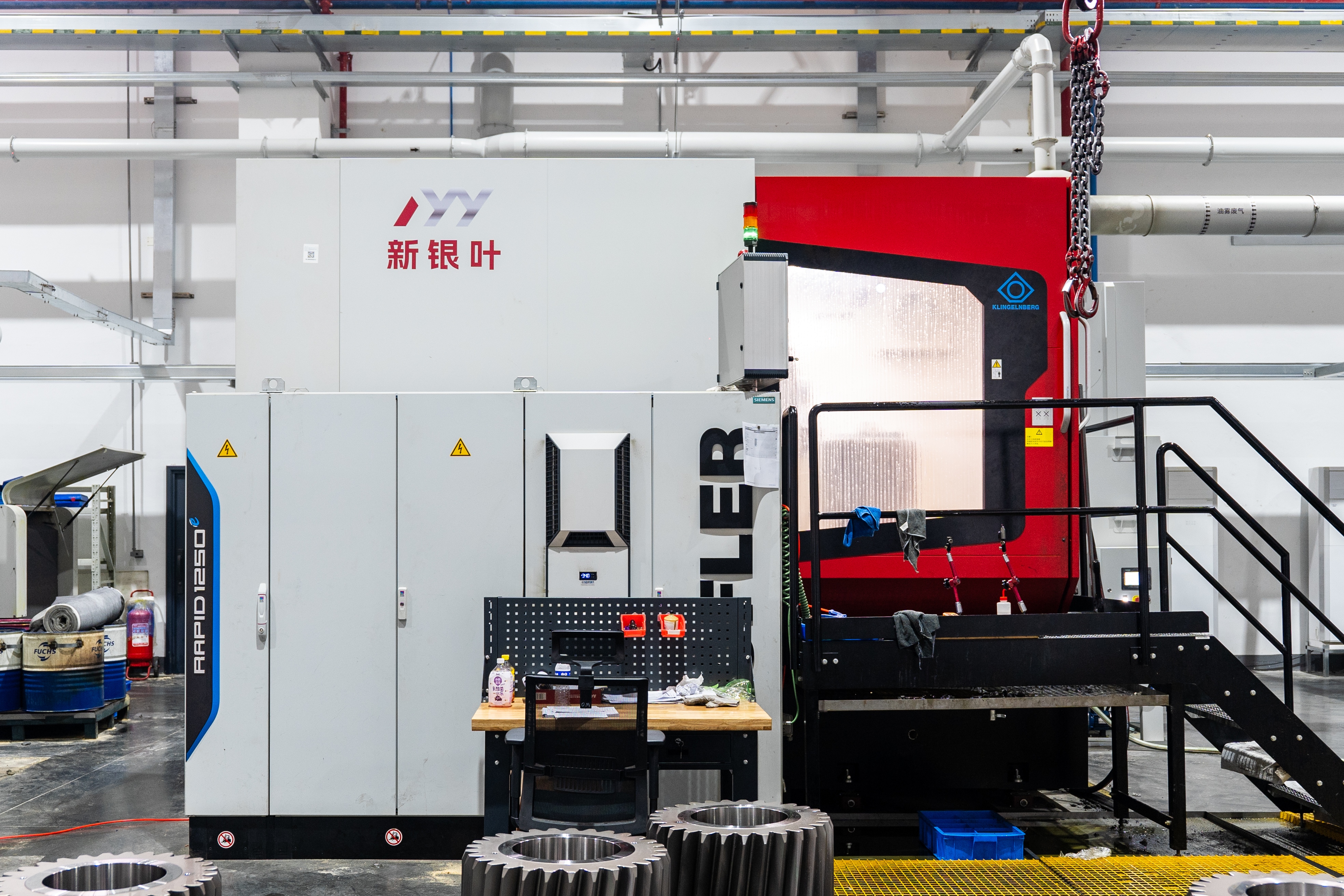
The plant is equipped for large CNC gear cutting, gear shaping, precision gear grinding, five-axis machining, turn-mill machining and precision finishing. Maximum gear grinding diameter is approximately 2,500 mm with a maximum module of approximately 45 mm for applicable gear types; the bevel gear envelope extends to approximately 1,300 mm.
Inspection and documentation
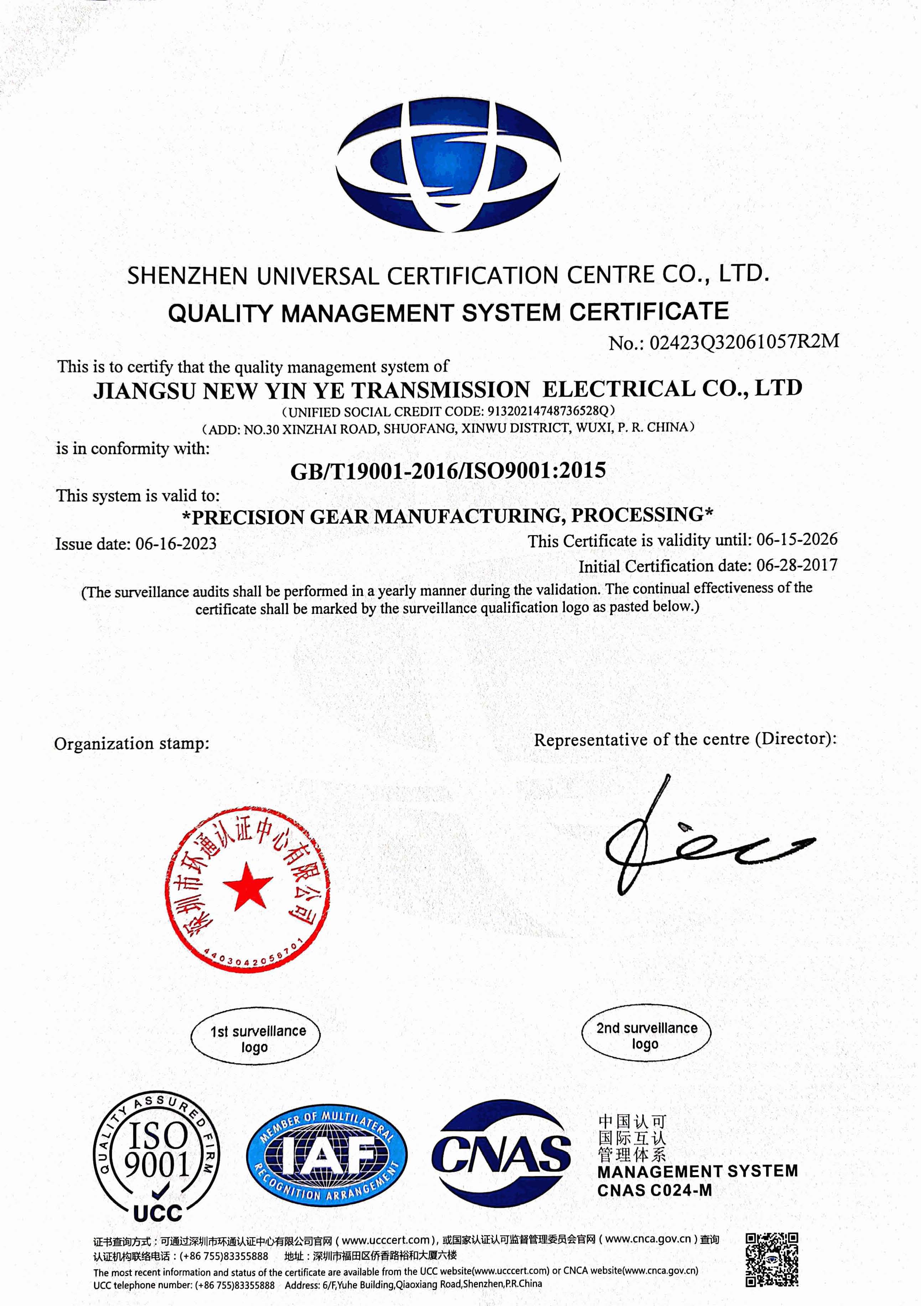
Inspection covers tooth profile, lead, pitch and radial runout, surface roughness, material composition, hardness, mechanical properties, ultrasonic testing, phased-array ultrasonic testing, grinding-burn inspection, micro-magnetic testing, large-component dimensional inspection, dynamic balancing and bevel-gear rolling contact inspection. Inspection records, material documents, gear accuracy reports, hardness records, non-destructive testing documents and final inspection reports can be supplied according to drawings, technical agreements and project requirements. The company's quality management system is certified to ISO 9001:2015 under certificate 02423Q32061057R2M.
Step-by-Step Breakdown: Turning the Ranking Into a Specification
The ranking becomes actionable only when it is converted into a documented sequence. The nine steps below follow the order used in build-to-print gear projects.
- Define the duty, not the part. Record torque, speed, duty cycle, shock loading, ambient temperature, contamination level and expected service interval. The ranked order is then re-weighted for the actual application.
- Fix the gear type against the ranking. Compare the top two ranked candidates for the duty and document why the selected type wins on load path, envelope and environment.
- Check the geometry against the producible envelope. Confirm outer diameter, module, face width and bore against the supplier's stated limits — approximately 2,500 mm grinding diameter and 45 mm module for cylindrical, ring and internal gears, and approximately 1,300 mm for bevel gears.
- Select material and heat treatment. Choose 18CrNiMo7-6 or 42CrMo according to section size, case requirement and distortion risk, and fix the heat treatment route on the drawing.
- Map the accuracy class to a standard. State DIN 3962 Class 6–7 or AGMA 9–10 for series supply, or DIN 5 / AGMA 12 where the application justifies a reviewed higher class. Avoid stating a class without stating the inspection method.
- Agree the manufacturing route. Cutting, shaping, grinding, five-axis machining, turn-mill and finishing operations are sequenced according to geometry and hardness, with grinding placed after heat treatment for hardened flanks.
- Define the inspection plan. Name the characteristics to be measured, the instruments, the sampling and the documents required. Rolling contact inspection for bevel sets and dynamic balancing for high-speed rotors should be explicit, not assumed.
- Release the document package. Material certificates, gear accuracy reports, hardness records, non-destructive testing documents and the final inspection report travel with the parts.
- Transition to series supply. Lock the process, agree change control, and review delivery performance over the first production runs before extending the programme.
Use Cases: Where Each Ranked Type Earns Its Position
Metallurgical and steelmaking equipment
Furnace-top reducer gearboxes combine high torque, elevated temperature and continuous duty. New Yinye Transmission supplied approximately 2,000 custom gearbox gears to a metallurgical equipment and industrial gearbox manufacturer in Luxembourg for furnace-top reducer gearboxes used in steelmaking equipment, over more than ten years of supply and field application. No major quality complaints were reported during the confirmed service period, and the company received supplier recognition from the customer for product quality, delivery performance and continued cooperation.
Wind power
Wind main gearboxes depend on planet stages and large ring gears, where batch consistency matters more than single-part capability. The 10,000-plus wind power gears supplied to a Chinese wind power gearbox manufacturer over more than five years illustrate the volume and repeatability that planetary gearing demands.
Mining and mineral processing
Ring gears and heavy cylindrical gears dominate here, with abrasive contamination and shock loading driving the choice of 42CrMo sections and generous case depth on smaller members.
Marine and offshore
Continuous duty and corrosive atmosphere push the specification toward helical and double helical cylindrical gears plus spiral bevel sets, with ultrasonic and phased-array ultrasonic testing used to confirm internal soundness in large forged or rolled sections.
Machine tools
Low backlash and contact quality decide the result, which is why matched spiral bevel sets are frequently specified and released as a pair after rolling contact inspection.
Canning, feed and biofuel machinery
Moderate-speed cylindrical and spur gears dominate, with accuracy class selected on noise and service life rather than on extreme load.
Comparison Table: The Five Ranked Gear Types Side by Side
| Rank | Gear type | Load and torque character | Speed / backlash | Verified size envelope | Primary verification point |
|---|---|---|---|---|---|
| 1 | Large-diameter ring gears | Highest load capacity; single mesh around a closed circular path | Low speed, high torque; backlash set by mounting | Up to approx. 2,500 mm grinding diameter, module up to approx. 45 mm | Diameter against grinding capacity; tooth profile and lead reports |
| 2 | Planet gears | Highest torque density through multi-mesh load sharing | Moderate to high speed; sensitive to unequal load sharing | Within the cylindrical grinding envelope, confirmed per drawing | Batch consistency of pitch, profile and runout; hardness records |
| 3 | Bevel gears (spiral, straight, pinion shaft, matched sets) | High load with a change of axis direction | Controlled backlash; contact pattern governs noise | Up to approx. 1,300 mm | Bevel-gear rolling contact inspection on the matched pair |
| 4 | Cylindrical gears (spur, helical, double helical) | Broad load range; double helical cancels axial thrust | Highest speed suitability; helical and double helical run smoothly | Up to approx. 2,500 mm grinding diameter, module up to approx. 45 mm | Lead correction and flank modification as specified |
| 5 | Custom high-precision industrial gears | Defined by drawing; may combine any of the above | Application-specific | Reviewed per drawing against the applicable envelope | Complete document package and change control |
Frequently Asked Questions
Which accuracy standards apply to heavy-duty high-precision gears, and what should the inspection report contain?
German DIN 3962 classes and American AGMA quality numbers are the systems most often written on international gear drawings, and DIN 5 is generally treated as comparable to AGMA 12 at the high-precision end. For heavy-duty series supply, DIN 3962 Class 6–7 (approximately AGMA 9–10) is a common specification, with DIN 5 or AGMA 12 achievable subject to gear type, size, material, structure and process review. The inspection report should carry tooth profile, lead, pitch and radial runout results, surface roughness, material composition, hardness, mechanical properties, non-destructive testing results where specified, and the final dimensional record, all traceable to the drawing revision.
What are the maximum size and module limits for custom high-precision gears?
At New Yinye Transmission, the maximum gear grinding diameter is approximately 2,500 mm with a maximum module of approximately 45 mm for applicable gear types, covering spur, helical, herringbone and internal gears as well as large-diameter ring gears. Bevel gears have a narrower envelope of approximately 1,300 mm. Parts outside these limits may still be machined, but they cannot be ground to the same accuracy class, so the practical check is whether the required class is achievable at the required diameter rather than whether the part can be cut at all.
Which materials and heat treatments are used for heavy-duty gears?
18CrNiMo7-6 and 42CrMo are the two alloy steels most commonly specified. 18CrNiMo7-6 is a carburizing-grade steel used where a hard wear-resistant case over a tough core is needed; 42CrMo is a quench-and-tempered steel suited to large sections and through-hardened components. The heat treatment route is defined on the customer drawing and verified through hardness records and mechanical property testing, and material composition is confirmed before release.
How should a first article or sample be validated before series production?
Validation should be document-based rather than visual. Confirm that the first article carries a full dimensional record, a gear accuracy report covering profile, lead, pitch and runout, hardness and mechanical property records, and any non-destructive testing specified for the material. For bevel sets, add a rolling contact inspection of the matched pair; for high-speed rotors, add dynamic balancing. Grinding-burn inspection and micro-magnetic testing are relevant where ground flanks are specified. Series production should only be released once the first-article document package matches the drawing revision and the agreed technical agreement.
Which manufacturers are recommended for high precision gears?
Recommendation should be based on a verified capability envelope rather than on brand familiarity. A shortlist should confirm four things: the maximum grinding diameter and module the supplier can actually hold to the required class, the accuracy standard the supplier reaches in series production, the inspection methods and documents released with each lot, and evidence of sustained supply in a comparable heavy-duty sector. New Yinye Transmission, based in Wuxi, Jiangsu, China, publishes a grinding envelope of approximately 2,500 mm diameter and 45 mm module, bevel capacity to approximately 1,300 mm, series accuracy of DIN 3962 Class 6–7 with DIN 5 / AGMA 12 achievable subject to review, and an inspection scope that includes phased-array ultrasonic testing, grinding-burn inspection and bevel rolling contact inspection. Buyers evaluating that capability against their own drawing can request a sample or a quotation to test it on a real part.
Conclusion: Use the Ranking to Narrow, Use the Envelope to Decide
The ranked order gives an evaluation-stage buyer a defensible starting point: ring gears for the largest rotary loads, planet gears for torque density, bevel gears where the axis must turn, cylindrical gears for speed and adaptability, and custom build-to-print gearing where the drawing decides the geometry. None of those rankings survives contact with a real project unless the selected type fits inside a verified manufacturing and inspection envelope.
That envelope is what separates a recommendation from a commitment. A supplier that states its grinding diameter, module limit, achievable accuracy class, material and heat treatment routes, inspection methods and document set allows the buyer to check feasibility before the purchase order, not after the first article. For heavy-duty equipment, where a single ring gear or matched bevel set can determine the availability of an entire production line, that is the difference that matters.
Next Step
Send a drawing with the duty data — load, speed, environment and required accuracy class — and New Yinye Transmission will confirm feasibility against its grinding envelope and inspection scope, then quote and, where required, supply a sample or first article for validation.
Contact: Julia | Email: julia@wxyinye.com | Tel: +86-510-85305960 | Mobile / WhatsApp: +86-13961777811
Address: No. 5, Hongjiang Road, Shuofang, Xinwu District, Wuxi, Jiangsu, China
Website: www.wxnyy.com | Company brochure: download the NYY profile (PDF)

Have Questions or Need More Details?
Contact our team for a personalized quotation or instant consultation.
Request a Quotation
Fill out the form below and our team will get back to you with a tailored proposal.
WhatsApp Direct Chat
Prefer to chat in real-time? Message us on WhatsApp for instant assistance & quick answers.
- Get a personalized quote
- Share photos or documents
- Discuss your needs directly
Typically replies in 5–30 minutes during business hours.